It is important to note that the work presented here represents the comprehensive design, analysis, and verification phase. These beams have not yet been manufactured. All calculations, stress checks, and stability analyses have been completed to ensure that the chosen specifications are theoretically sound, safe, and compliant with international standards, providing a validated blueprint ready for the fabrication stage.
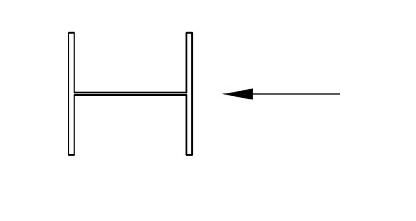
This project involved a comprehensive structural analysis, focusing on submerged HEA steel beams exposed to various flow velocities in seawater. Our methodology was governed by established European standards, ensuring safety and reliability. The analysis considered a range of standard HEA beam dimensions, carefully selecting a cross-section to meet the structural demands and verify the design against all potential failure modes.
Force Determination and Bending Moment
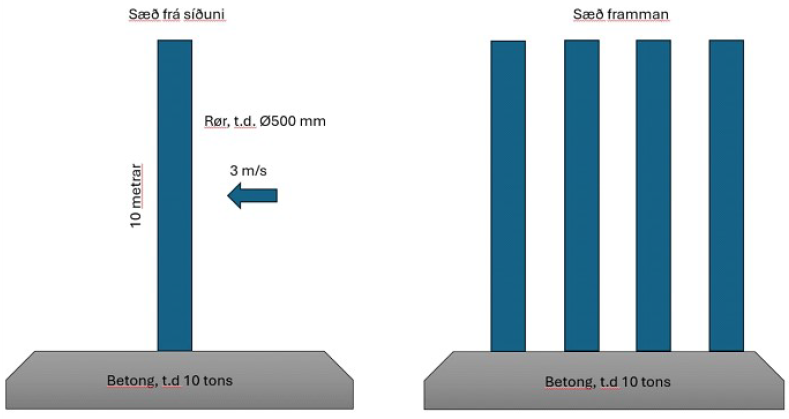
The heart of the project involved multiple steps of verification to confirm the beams’ ability to withstand the forces of the sea current. We first calculated the force from the sea current acting on the structure. This was based on the reference area of the beam and incorporating a drag coefficient. This force was then used to determine the bending moment at the critical point—the bottom of the pipe—which is essential for evaluating stress The stress in cross-section was determined by dividing the calculated bending moment by the elastic moment resistance of the selected beam section. This led directly to the utilization against yielding, which confirms the theoretical design’s performance relative to the yield strength of the S355 steel.
Natural Frequency and Vortex Shedding
We calculated the natural Frequencies of the structure using Euler-Bernoulli beam theory, considering the Young’s modulus of steel and the beam’s geometric properties. This was extended to determine the natural frequencies in sea water by including the crucial factor of added mass from the surrounding water.
Vortex Shedding Analysis
The phenomenon of vortex shedding—where oscillating lift forces can be induced by the flow—is a primary cause of fatigue and resonance in submerged structures. Using the cross-section dimensions and the Strouhal number, we determined the critical sea current velocity. This critical velocity was then compared to the actual flow velocity to ensure the theoretical design is protected from resonance. The design mandated that the critical velocity must be significantly higher than the operational flow velocity, providing a robust safety margin.
Conclusion
This project exemplifies our ability to apply advanced engineering principles and European structural standards to complex marine environment challenges. By meticulously calculating forces, checking against yielding, and verifying dynamic stability through frequency and vortex shedding analysis, we have successfully developed a structurally sound and verified theoretical design ready for fabrication. This process highlights our expertise in delivering reliable and compliant engineering solutions from the conceptual stage through to production readiness.