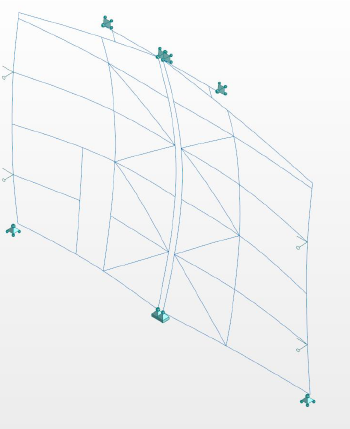
Verifying the Structural Integrity of a High-Performance Steel Door
Challenge: Designing for Extreme Wind Loads
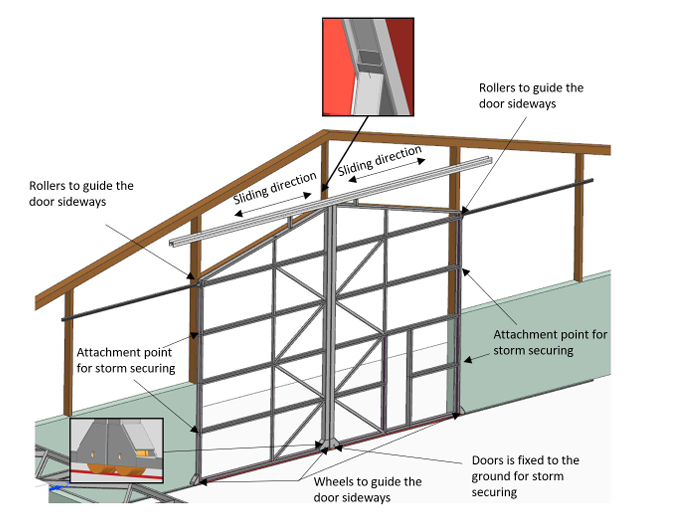
The objective of this project was to perform a rigorous structural analysis on a large steel door to ensure its integrity and safety, particularly when subjected to extreme wind conditions. The door, designed to operate in two independently sliding sections, is guided by rollers at the top and wheels at the bottom. To meet the high safety standards required, the analysis was conducted using the following specifications:
1. Design Standards and Materials
- Codes: The verification followed European structural design standards, specifically Eurocode (DS/EN 1990, DS/EN 1991-1-4, and DS/EN 1993-1-8).
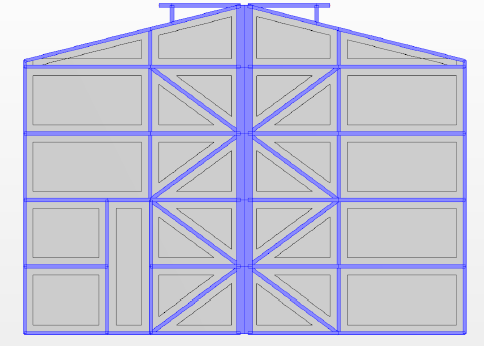
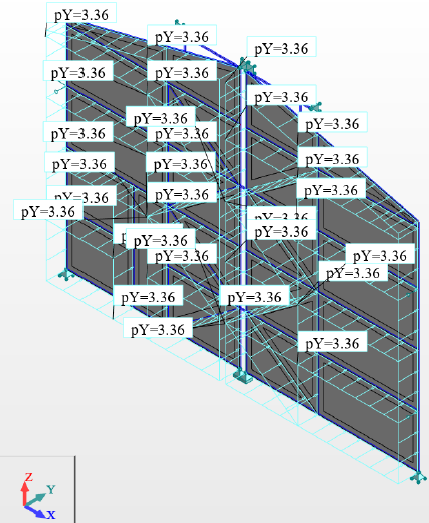
- Software: The structural model, composed of beam elements, was created and analyzed using Autodesk Robot.
- Material: The door members utilize S355J2 steel, a high-strength material providing excellent structural performance.
2. Investigated Load Cases
The design was tested against three critical load scenarios based on relevant design standards:
| Load Case | Description | Governing Load | Key Requirement |
| Ultimate Limit State (ULS) | Structural integrity against maximum expected wind gusts. | Extreme wind load based on a velocity of 60.1 m/s. | Must not collapse or yield permanently. |
| Serviceability Limit State (SLS) | Ensuring the door remains functional and operable. | Operational wind load based on a velocity of 23 m/s. | Maximum deflection must be within acceptable limits to ensure proper function. |
| Lifting | Verifying the structure can handle its own weight safely during installation. | Self-weight (Gravity). | Must be safe for upending and handling. |
Results and Structural Verification
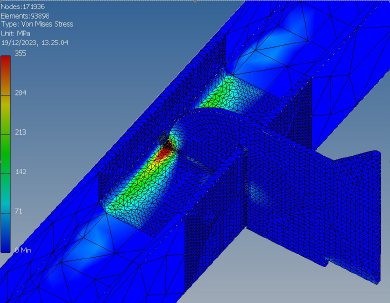
The analysis successfully validated the door’s capacity under all scenarios, confirming the design’s robust performance. The analysis confirmed that the maximum utilization ratio for all beam members remains well below the limit, indicating a substantial safety margin against structural failure under extreme wind loads.
The maximum deflection of the steel door under this load case was calculated and found to be within acceptable engineering tolerances.
Under the lower, operational wind loads, the structure maintained high serviceability. The overall utilization and deflection were minimal, confirming that the door will perform reliably and remain easy to operate under typical wind conditions. The structure was found to be safe for upending and handling during the installation process, confirming its ability to safely carry its own weight without damage.
The structural verification report confirms that the steel door possesses the necessary structural capacity to withstand the specified design wind forces, including both the 10-minute mean velocity and the 3-second gust. This successful analysis ensures the long-term safety, reliability, and functionality of the steel door for our client.